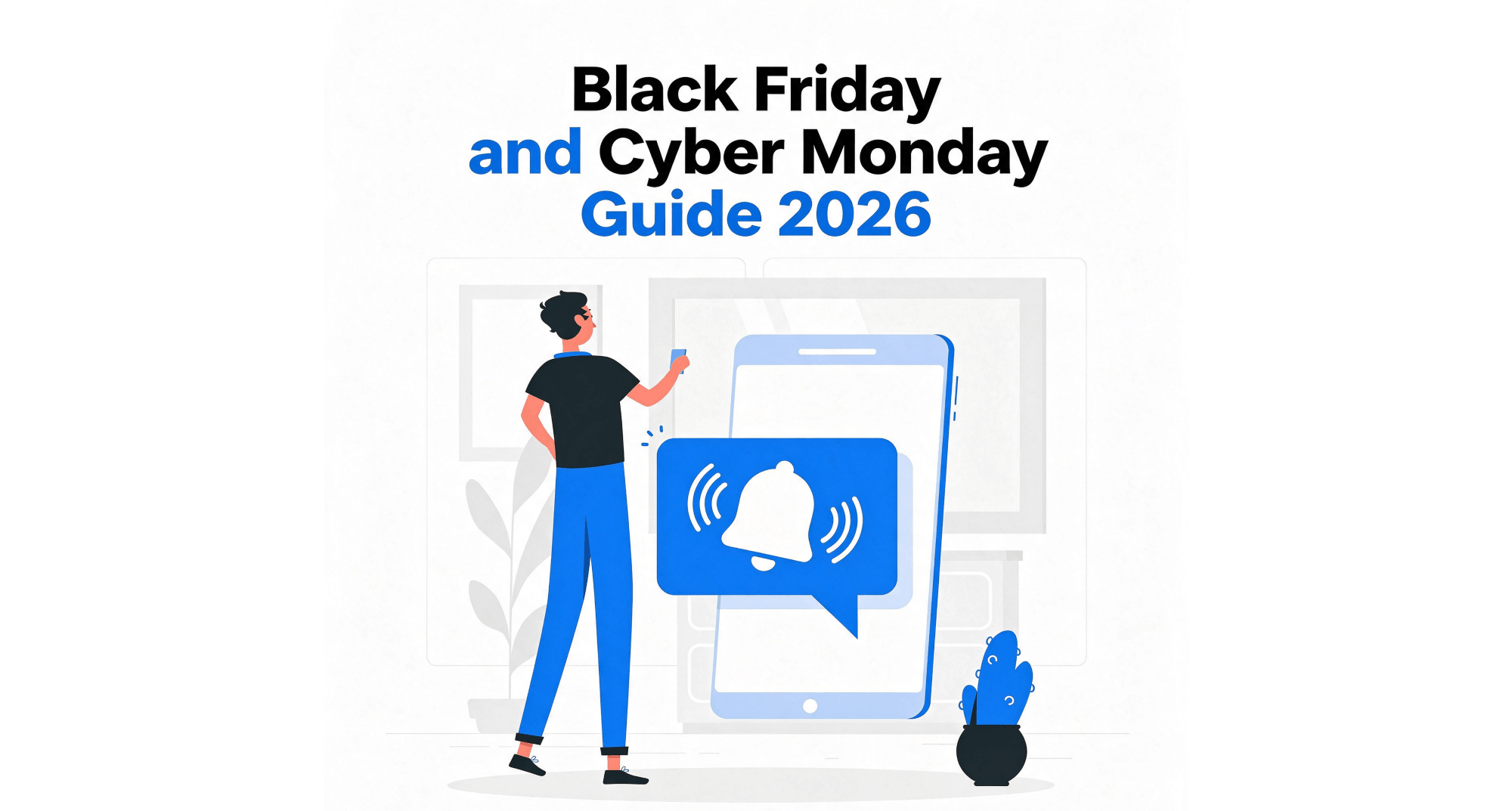
Black Friday and Cyber Monday Guide 2026 – BFCM
Where we’d start if it were our store
Black Friday is November 27, and Cyber Monday is November 30. Whether you’ve been preparing for weeks or are only just starting, here’s where we’d focus first.
If you began collecting push subscribers in October, you’re ahead, and you can skip to the campaign sections. If you didn’t, you still have time. We’d rather see a store send three well-aimed notifications than try to launch a twelve-part journey it hasn’t tested.
Here’s the short list we’d work through first:
- Check that visitors can subscribe and that you can send to them.
- Build one sale page for your Black Friday notification to land on.
- Schedule a Black Friday launch message and a Cyber Monday message.
- Turn on one abandoned-cart reminder that stops itself when someone buys.
- Pick up your phone, tap a test notification all the way through to payment, and fix whatever breaks.
The rest of this guide explains how to do those well, and what to add if you have more time.
What’s happening with shoppers this year
Adobe’s holiday forecast expects US shoppers to spend $275.1 billion online across November and December, up 6.7% on last year. It projects $47.5 billion for Cyber Week, with $12.9 billion on Black Friday and $15.1 billion on Cyber Monday, and discounts reaching around 30% in some categories.
The number we find more useful comes from the National Retail Federation’s October research. It found that 43% of holiday shoppers planned to start before November, yet 64% expected to do most of their shopping over Thanksgiving weekend.
That gap is the opportunity. Plenty of people have already chosen the laptop, the jacket or the sofa, and they’re waiting for a price they like. They visited your store weeks ago and left. Whether they come back to you or buy elsewhere often depends on whether you can reach them at the right moment. That’s what web push is for.
What push does well, and where it falls short
A web push notification reaches someone’s screen even when your site isn’t open. They don’t need to give you an email address or install an app. They click Allow once.
That makes it a good fit for short, timely nudges:
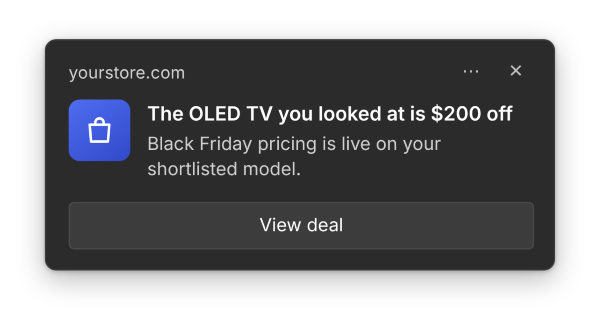
The OLED TV you looked at is $200 off. Black Friday pricing is live on your shortlisted model.
The message works because it’s about something the shopper already cares about. Push notifications should complement your other channels. For longer gift guides you can use email, and use push notifications to nudge them to make the purchase.
Getting people to say yes
Timing matters more than wording
Imagine opening a product page on your phone and getting a cookie banner, an email popup and a browser notification request before you’ve seen the price. You’d close all three. Your visitors do the same.
Ask after someone has shown real interest, and tie the ask to something they’d want. A laptop page can offer a price-drop alert. A sold-out sneaker page can offer a restock alert. A Black Friday preview page can say:
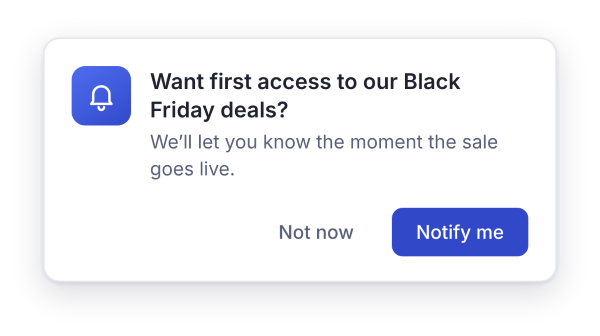
Want first access to our Black Friday deals? We’ll let you know the moment the sale goes live. Notify me
The iPhone caveat
On iOS and iPadOS, web push works only for websites that a customer has added to their Home Screen. Browsing in Safari doesn’t give you the same opt-in experience as desktop Chrome or Android. Adobe expects phones to account for 57.4% of US online holiday spending this year, so find out what share of your own mobile visitors can actually subscribe.
What’s a normal opt-in rate?
There isn’t one number. BinaryBriefing analyzed July 2026 Chrome data from 77,819 eligible sites and found an average acceptance share of 19.9% and a median of 13.38%. The most common response, at 44.82% on average, was ignoring the prompt.
Two caveats. Those figures describe responses to the browser prompt, not completed subscriptions. And they’re averages across all kinds of sites, so they aren’t an ecommerce benchmark. The comparison that matters is your own store: mobile against desktop, product pages against landing pages, this month against last.
How often is too often?
Black Friday tempts you to send everything. You have more offers than at any other time of year, and each one feels urgent. But your customers are hearing from dozens of other brands as well. Send too much and they’ll turn you off, and Chrome has been adding protections against disruptive notification practices, including non-invasive permission prompts, permission revocation and engagement-based limits. Frequency is a platform issue as well as a courtesy.
This is the schedule we’d start from. Treat it as a starting point, not a rule.
| Dates | What to do | How many |
|---|---|---|
| Nov 11–16 | Test everything, set up segments, promote early-access signup | Little or nothing |
| Nov 17–22 | Introduce featured products | 1–2 for engaged subscribers |
| Nov 23–25 | Build anticipation, confirm launch details | 2–3 across the period |
| Nov 26 | Early access, if you promised it | 1 |
| Nov 27 | Black Friday launch | 1 main message, plus targeted follow-ups |
| Nov 28–29 | Weekend deals, Cyber Monday preview | At most 1 a day, engaged subscribers only |
| Nov 30 | Cyber Monday | 1 main message, plus 1 final reminder if it’s genuinely the last chance |
| Dec 1 onward | Back to normal | Normal |
The thing that trips teams up is overlap. Say your Black Friday launch goes out at 9 AM. A customer clicks, adds two items to their cart and leaves, so the cart reminder fires. Meanwhile someone has scheduled a flash sale for lunchtime. That’s three messages before 2 PM.
Decide in advance which message wins. A reminder about items someone put in their cart usually beats a general promotion. Anyone who has already bought should be excluded from further messages about that offer. And count messages per person, not per campaign: you can run several campaigns in a day if they reach different groups.
What to send, by type of store
Fashion. Shoppers look at the same jacket several times before buying. Message the people who viewed it, and watch your stock. If only a few sizes remain, a blast to everyone sends a lot of disappointed clicks.
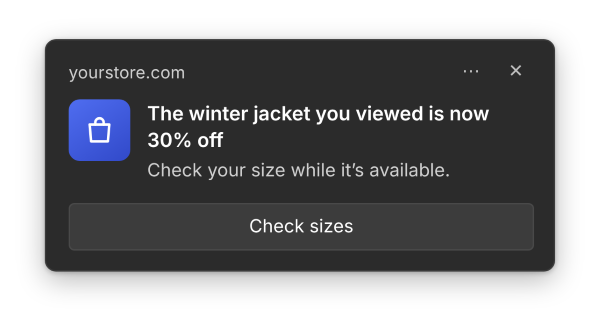
The winter jacket you viewed is now 30% off. Check your size while it’s available.
Electronics. People research these for weeks. A real price drop on the exact model someone has been watching is worth more than ten generic “deals are live” messages. Send them to that product or a filtered collection, not the homepage. For a $1,500 purchase, warranty, delivery and returns can matter as much as the discount.
Beauty. Bundles and replenishment work well here. Build a routine, such as a cleanser, moisturizer and serum, and price it well. Check the margin first, because a bundle that looks generous but eats your profit isn’t a win. And don’t push a big reorder at someone who stocked up last week.
Stores with physical locations. Tell people when a sale item is available for pickup at their store. This only works with accurate inventory data, since an alert that sends someone to an empty shelf does more harm than good.
Subscriptions. Be careful with deep first-month discounts, which can bring in people who cancel before paying full price. Annual plans are often the healthier offer. Treat trial users, monthly subscribers and prospects differently, leave existing annual members out of new-customer offers, and make renewal pricing easy to find. Judge the promotion by renewals and lifetime value, not signups alone.
Automations worth setting up
Scheduled messages announce the sale. Automated ones respond to what an individual shopper does. Over a busy weekend, when people hop between stores, the second kind can win sales the first kind misses. PushAlert supports scheduling, segmentation, A/B testing and triggered notifications, including abandoned cart drip campaigns and product-based Custom Drip campaigns.
Abandoned carts
Baymard Institute’s research puts the average documented cart abandonment rate at about 70%. That doesn’t mean 70% of shoppers were ready to buy and forgot. Plenty were comparing prices or never planned to buy that day.
So make the reminder useful, not pushy. We’d start with one about 45–60 minutes after abandonment:
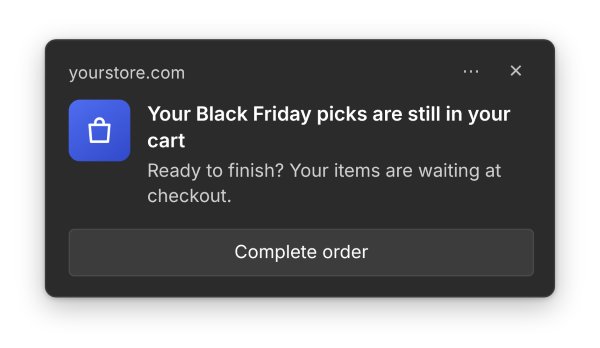
Your Black Friday picks are still in your cart. Ready to finish? Your items are waiting at checkout.
If they still haven’t returned, a second message later that day can mention a real deadline or a shipping benefit. We’d avoid a new discount on every abandonment, because shoppers learn quickly that leaving checkout earns a coupon. And make sure the flow stops the moment someone buys.
Price drops and back-in-stock alerts
One product view isn’t a buying signal. Three visits plus a signup for price alerts is. Alerts that report a real change, like a lower price or a size that’s back, work well. Repeating a reminder about something that hasn’t changed doesn’t. All of it depends on accurate price and inventory data, because an alert for a discount that expired an hour ago costs more trust than it earns in clicks.
What we saw in BFCM 2025
On Black Friday 2025, PushAlert recovered more than 50,000 abandoned carts for retailers. We count a cart as recovered when a shopper clicks a push notification, returns to their cart and completes the purchase within 24 hours of adding the product. Abandoned cart drip campaigns recovered 13.4% more carts than single reminder notifications. Our product-based Custom Drip campaigns averaged a 15.2% click-through rate across the event.
Your own results will depend on your audience, your offers and your timing, so measure them as you go.
Don’t give away margin you don’t need to
If a jacket would sell out at 20% off, taking it to 30% mostly shrinks your profit. Keep the deeper discounts for slower stock.
Price also isn’t the only lever. NRF’s research points to quality, selection and shipping promotions mattering alongside discounts. A store that can promise reliable delivery or easy returns has something worth saying. You can test it: send half your audience a small extra discount and the other half free shipping, and see which brings more profitable orders. PushAlert’s A/B testing is built for exactly this kind of comparison.
One note on bundles. They work when the products belong together, like a desk and a chair or a cleanser and a moisturizer. They don’t work when padded with things nobody wanted.
Check the checkout before you send anything
There’s no point driving interested shoppers to a checkout that makes them give up. Baymard’s research lists extra costs, slow delivery, payment concerns and complicated checkout among the main reasons people abandon orders.
Before Friday, do the full walk-through on your phone. Does the notification open the right page? Does the price match? Do the coupon codes work? Can people see shipping costs before they pay? Fixing a small snag now is worth more than a better subject line.
Work out whether it actually worked
Clicks feel good but they don’t pay the bills. Here’s a made-up example. You send a notification to 40,000 subscribers and get a 4% click rate, which is 1,600 clicks. If 5% of those visitors buy, that’s 80 orders, and at $90 each you have $7,200 in attributed revenue.
Then subtract discounts, shipping subsidies, product costs and returns. And be honest about attribution, because some of those buyers would have come back without any notification. If your list is large enough, hold out a small random group who don’t get the message. Comparing them with everyone else is the cleanest way to see what the campaign added.
Also watch whether new subscribers stick around. A list that doubles in November and goes quiet in December isn’t worth much.
PushAlert’s newer AI-assisted features can help you draft notification copy, create variations and set up welcome messages, drip campaigns and triggered notifications. They’re arriving through our V2 dashboard, and availability depends on rollout. Whatever tool does the drafting, have a person check prices, timing and audience before anything goes out.
Don’t forget the week after
Black Friday brings lots of first-time customers, and what you do in the next few days decides whether they return. Right after checkout, order updates matter more than another promotion. A little later, a useful guide, a replenishment reminder or a loyalty perk can bring them back for a second purchase.
Write down what you learned while it’s fresh: which products people were watching, which segments bought, whether early access beat general announcements, and whether your cart reminders helped or just piled on. That list is the start of next year’s plan.
The short version
Send fewer, better messages. Send them to people who asked to hear about that thing. Make sure the page they land on works. And protect your list, because when the sale ends, the people who chose to hear from you are the part worth keeping.