Push Notifications Owned Audience for Publishers
Publishers spend a lot of time thinking about traffic. Where will the next reader come from? Will the latest article rank on Google? How much traffic will social media send this week? Is paid acquisition still worth the cost? These questions are part of running a digital publication today. Creating the content is only one part of the job. Publishers also have to find readers for that content, bring them to the website and find ways to keep them coming back. That last part often gets less attention than it deserves.
A reader may discover an article through Google, social media, a recommendation platform or a paid campaign. They read the story and leave. The publisher has invested in producing and distributing that article, but there is no guarantee that the same reader will return tomorrow.
Web push notifications give publishers a simple way to build an owned audience of subscribers they can reach directly whenever there is something worth bringing them back for. Instead of depending on Google, social media or another platform to find the reader again, publishers can use web push to send relevant stories and updates straight to their browser. A reader subscribes once, and that subscription gives the publication a direct channel for bringing them back to the website.
PushAlert helps publishers build and use this audience through automated, manual and scheduled notifications, along with features such as RSS to Push, dynamic segmentation, REST API integrations and AI-powered campaign creation.
The first visit is not the end of the relationship
An editorial team spends hours producing an article. The SEO team works on getting it discovered. Social teams distribute it across different platforms. Marketing teams may promote it through paid campaigns. Partnerships and content recommendations can also play a role. All of that work gets a reader to the website. If the reader visits once and disappears, the publisher has to go through the same process again the next time it wants that person to read something.
When a reader subscribes to push notifications, the publication can reach that reader directly when another relevant story is published. The reader doesn’t have to search for the publication again or happen to see its latest post in a crowded social feed. That second visit may not sound significant on its own. Across thousands or millions of readers, however, repeat visits can become a meaningful source of traffic.
For an ad-supported publisher, those visits create additional pageviews and advertising opportunities. For a subscription publisher, they provide more opportunities to bring readers back to valuable content. For an affiliate publisher, they can send readers back to articles that generate commercial conversions. The business model changes, but the basic idea stays the same, to get more value from the readers you already acquired.
RSS to Push can fit into the daily publishing workflow
A practical challenge with owned audience marketing is making it fit into the way a publication already works. Take a digital newspaper that publishes continuously throughout the day. The newsroom may publish dozens of stories between breakfast and late evening. Breaking news can appear at any time, and there isn’t necessarily an editor available to create a separate notification campaign every time something important goes live.
The newspaper may already have an RSS feed coming from its CMS or WordPress installation. With PushAlert’s RSS to Push feature, that existing feed can be used to automatically send new articles to subscribers.
A major political story breaks at 11:30 AM. The newsroom publishes the article, the RSS feed updates, and PushAlert can use that new item to trigger a push notification. The reader doesn’t have to come across the story on social media several minutes later. They can receive an alert and return directly to the newspaper’s website.
The same setup can work for a publication that publishes throughout the day on a particular beat. A technology newspaper might use its technology RSS feed to notify subscribers whenever a new story is published, while a sports publication could do the same for its sports section. That matters even more when the newsroom is publishing dozens of stories a day. The editorial team can continue using its normal CMS and publishing process while PushAlert takes care of another distribution channel in the background. The publication can also control how many notifications it sends each day and how frequently they go out. The publisher can still decide which feeds should generate notifications and how the messages should be handled.
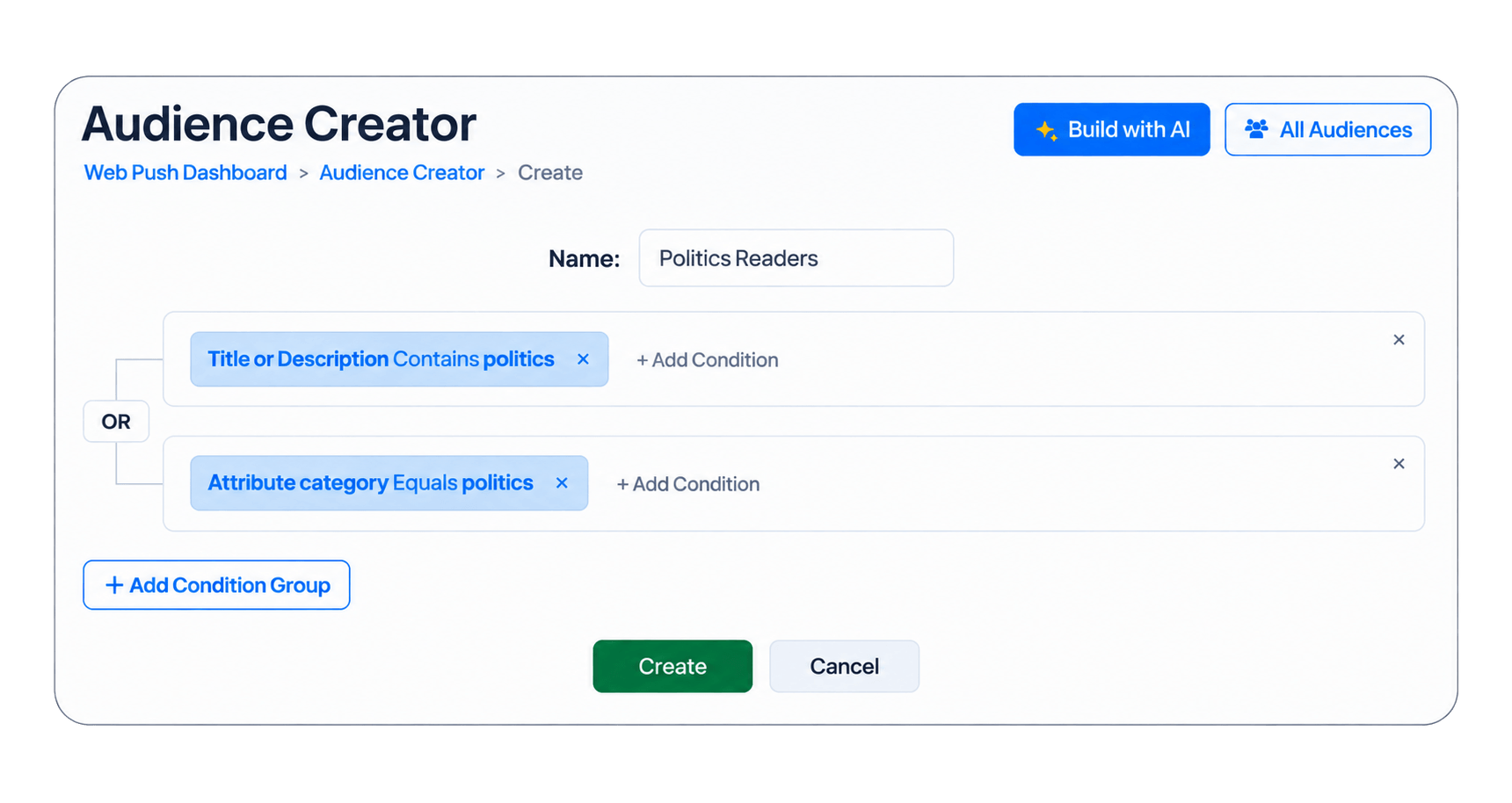
Dynamic Segments for Publisher News Categories
Dynamic segments make a large audience easier to manage
The same publication might have a reader who opens every cricket story but rarely reads politics, another who follows business news closely, and another who primarily reads national and international affairs. Sending every article to all three people isn’t going to make the notification channel very useful for long. Dynamic segmentation can help the newspaper make those notifications more relevant.
Imagine a newspaper with separate sports, politics and business sections. When an important cricket match is underway, the newspaper can send a result or major update to its sports audience without sending the same notification to readers who have shown little interest in sports. A significant election development can be sent to readers interested in politics. A major market movement or company announcement can be pushed to business readers.
More relevant targeting also gives the newspaper room to communicate with its audience without making every subscriber feel like they are receiving the same stream of messages. This reduces notification fatigue and makes readers come back for content they already consume.
The API can connect notifications directly to the newsroom
RSS works well when the trigger is simply “a new article has been published.” But newsrooms often have events that are more specific than that.
A digital newspaper may have a CMS with different editorial workflows for breaking news, live blogs, election coverage or market updates. It may also have its own systems for sports scores, weather alerts or financial data. The REST API allows the publisher to connect these systems to PushAlert.
Suppose a newspaper has a live sports section. When a cricket match ends, its CMS or sports system already knows the final score. Instead of asking an editor to log into a separate notification dashboard and manually send the result, the newspaper can use the API to trigger a push notification from its own system.
The same approach can work for breaking news. An editor marks a story as “breaking” in the CMS or WordPress. That action can be used as a trigger for the notification workflow, sending an alert to the appropriate subscribers as soon as the story is published.
A financial publisher could take a similar approach with market alerts. When its internal system records a major movement or an event that meets a predefined condition, it can trigger a notification through the API. The notification system can then work alongside the publisher’s existing technology, without requiring editors to maintain a separate process for every alert. For publishers with their own development teams, that can make notifications much easier to incorporate into the daily workflow.
Scheduling works well for content that has a rhythm
Not every notification needs to be tied to the exact moment an article is published. Most digital newspapers have content that follows a fairly predictable rhythm. There may be a morning briefing, an afternoon update and an evening roundup. Some publications also prepare newsletters, podcasts or daily explainers at specific times. PushAlert’s scheduling capabilities can be used to support these routines.
A newspaper could prepare a morning notification around 7:30 AM that takes readers to its daily briefing. Later in the day, it might send an evening roundup highlighting the biggest stories that happened since the morning. The editorial team can prepare the content when it is ready rather than having to remember to send the notification at the exact time. The campaign can be scheduled in advance and delivered when the publication wants its readers to see it.
For a publisher with readers in different countries, time-zone scheduling can further help with better click-through. A story intended for readers in India doesn’t necessarily need to arrive at the same local time for readers in the UK or the US. Planning notification delivery around the audience can make the channel more useful without requiring someone to be available around the clock.
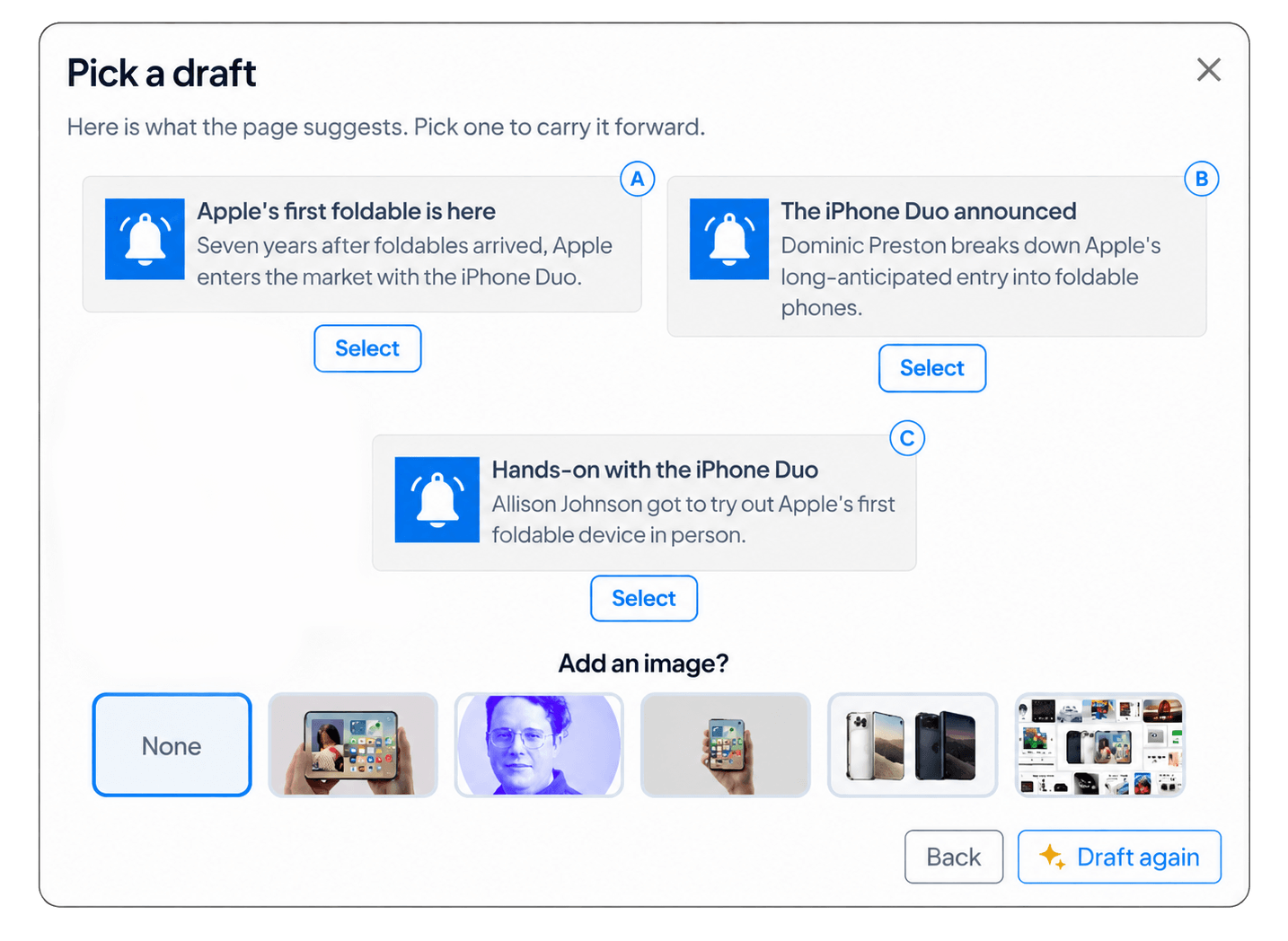
Generate Notification Drafts from URL using AI
AI becomes useful when there are dozens of notifications to write
A large editorial team might have dozens of stories that could reasonably be promoted through push during a day. The headline is already written, the article is already edited and the URL is ready. What is left is creating a short message that makes sense in the limited space available in a push notification. Doing that once is easy. Doing it 30 or 50 times a day is another matter.
PushAlert’s AI can take some of that repetitive writing off the editorial team’s plate.
An editor can provide a simple instruction based on the article and ask AI to turn it into notification copy. For a breaking story, the prompt might be:
“Write a concise push notification for this breaking news story. Make it informative and urgent without sounding sensational.”
For a longer feature, the editor could ask:
“Create three push notification options for this article. Keep them concise and focus on the main reason a reader should open the story.”
The editor can choose an option, make any changes and send it. The process doesn’t remove the editorial decision; it simply reduces the time spent getting from an article to a usable notification. AI can also help when publishers want to experiment with different versions of a notification. Instead of manually writing several alternatives for an A/B test, the team can use AI to produce variations and then see which version performs better.
Automation handles the predictable work while editors handle the important stories
A publisher doesn’t need an editor manually pushing every routine article. RSS to Push and automated workflows can take care of much of that distribution. At the same time, the editorial team can manually send notifications when a story deserves special treatment.
Breaking news is an obvious example. If a major event happens, an editor can decide exactly what the notification should say, which audience should receive it and when it should go out. PushAlert gives publishers the flexibility to handle both situations. Routine content can move through automated workflows, while important stories can receive a more deliberate editorial push. Publishing workflows don’t have to be completely automated or completely manual. Automation can handle the repetitive work while editors remain in control of the stories that need their attention.
PushAlert adds a retention layer to the traffic publishers already generate
Publishers will continue to invest in SEO, social media, paid acquisition, partnerships and other channels that bring new readers to their websites. Those channels are necessary for growth. But acquisition shouldn’t be the only focus.
Once a reader arrives, there is value in giving that reader a reason to come back. An owned audience provides a way to do that without depending entirely on another platform to deliver the next visit.
PushAlert gives publishers a way to build that retention layer into their existing workflow. Web push can bring readers back to the stories they care about, creating more opportunities for traffic, engagement and revenue without requiring the publisher to keep paying for every visit.